Student Visa Financial Capacity Guide: Showing Indian Funds in 2026
Cooper
Editor, VisaClarity Australia
Published June 1, 2026Last reviewed
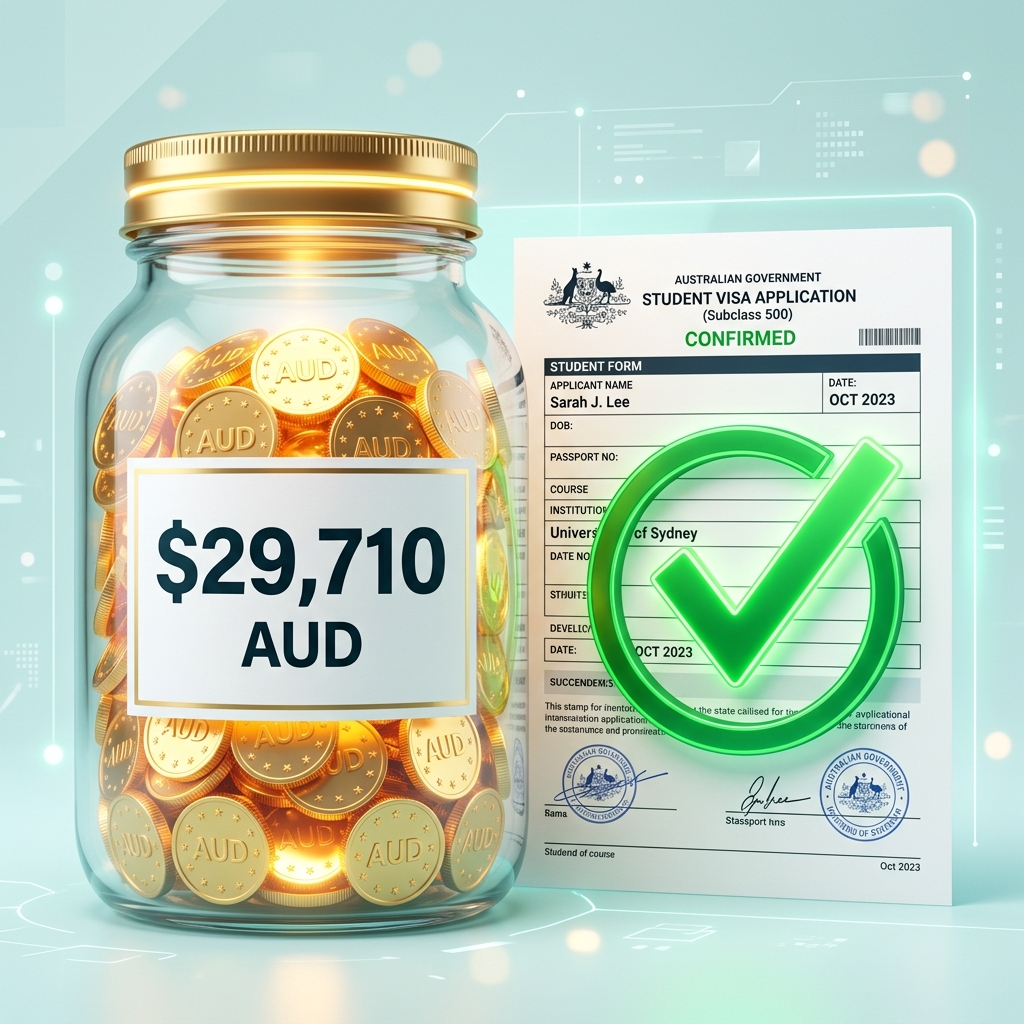
Indian applicants for the Australian Subclass 500 Student Visa must demonstrate a minimum financial capacity of $29,710 AUD in annual living costs, plus first-year tuition fees and travel expenses. The Department of Home Affairs requires funds to be held in liquid accounts by approved close family sponsors, backed by verifiable source-of-funds evidence.
The 2026 Financial Capacity Formula
To secure an Australian student visa, you must prove you have sufficient funds to cover your travel, tuition, and living costs. The Department of Home Affairs indexes these amounts regularly. The baseline living cost requirement is $29,710 AUD for the primary applicant.
If you are applying with family members, your financial capacity calculation must include: * Primary Applicant Living Cost: $29,710 AUD per year. * Accompanying Partner/Spouse Living Cost: $10,394 AUD per year. * Accompanying Child Living Cost: $4,449 AUD per year per child. * First-Year Tuition Fee Balance: The total first-year tuition fee minus any deposit or tuition payment already made (as shown on your Confirmation of Enrolment, or CoE). * Travel Costs: $2,000 AUD per person (if applying from outside Australia). * School-Aged Child Cost: $13,502 AUD per year for each school-aged child (5 to 18 years old) to cover schooling costs in Australia.
Additionally, the non-refundable primary application fee for a Subclass 500 visa is $2,000 AUD (effective 1 July 2025).
You can compute your specific financial requirements using our online /tools/funds-calculator.
Approved Sponsors and Acceptable Funding Sources
The Department of Home Affairs applies strict criteria to Indian applicants regarding who can sponsor their education and where the funds must be held.
1. Who Can Sponsor Your Visa?
You cannot use funds from distant relatives or family friends. The department only accepts financial support from: * Yourself (the student). * Your spouse (husband or wife). * Your parents. * Your siblings (brothers or sisters). * Your grandparents.2. What Funds are Acceptable?
Funds must be immediately accessible and liquid. The following sources are accepted: * Savings and Current Accounts: Held in public, private, or cooperative banks. * Fixed Deposits (FDs): Preferably held for at least 3 months to demonstrate genuine savings. * Gold Loans: Secured from recognized public or cooperative banks, provided the loan sanction letter and disbursement terms are clear. * Education Loans: Disbursed by approved nationalized, private, or cooperative banks.Unacceptable funds include shares, mutual funds, property valuations, cooperative society savings (unless a bank license is held), and cash-in-hand.
You can read more about student visa rules on our /visas/student-500 page.
The "Sudden Deposit" Audit Trap
Visa officers scrutinize Indian bank statements to identify "non-genuine funds." If a large transaction (such as 10 Lakhs INR) is deposited into your sponsor's account shortly before lodging the visa application, the case officer will flag it.
If you cannot show the legal origin of the deposit, the visa will be refused under genuine student requirements. To avoid this, you must provide independent documentation for any recent lump-sum deposits: * Sale of Land or Property: Registered sale deeds and bank records showing the buyer's transfer. * Agricultural Income: Government-issued J-Forms or agricultural tax records. * Business Income: Audited profit and loss statements, business registration papers, and tax filings. * Retirement / Provident Fund Disbursals: Official statements showing the payout details.
Table: Student Visa Financial Requirements Calculation (Single vs. Couple)
The table below compares the minimum funds required for an Indian student migrating alone versus a student migrating with a partner (assuming first-year tuition fees are $35,000 AUD, with a $10,000 AUD deposit already paid).
| Financial Component | Single Student (AUD) | Student with Spouse (AUD) |
|---|---|---|
| Living Costs (1 Year) | $29,710 | $40,104 ($29,710 + $10,394) |
| Tuition Balance (1st Year) | $25,000 | $25,000 ($35,000 - $10,000) |
| Travel Allowance | $2,000 | $4,000 ($2,000 per person) |
| Primary Visa Fee | $2,000 | $2,000 (Plus partner fee extra) |
| Total Funds to Demonstrate | $58,710 AUD | $71,104 AUD |
Sources
- [Student Visa Financial Capacity], Department of Home Affairs, https://immi.homeaffairs.gov.au/visas/getting-a-visa/visa-listing/student-500#Eligibility, Checked 4 June 2026. - [Student Visa Fee Changes], Department of Home Affairs, https://immi.homeaffairs.gov.au/news-media/archive, Checked 4 June 2026. - [Document Checklist Tool], Department of Home Affairs, https://immi.homeaffairs.gov.au/visas/web-evidentiary-tool, Checked 4 June 2026.Frequently Asked Questions
Can an uncle or aunt act as a sponsor for an Indian student?
No. Distant relatives, including uncles, aunts, cousins, and family friends, are not recognized as acceptable sponsors for Indian student visa applications under current Department of Home Affairs guidelines. Using funds from these sources routinely leads to visa refusals.Do I need to show funds for the entire duration of a 3-year degree?
You only need to show evidence of funds to cover the first 12 months of your stay in Australia. However, you must demonstrate that you have access to a sustainable source of income (such as parents' employment or business profits) to cover the remaining years of your study.Can I show funds in a Public Provident Fund (PPF) or Employee Provident Fund (EPF)?
Yes, PPF and EPF accounts are acceptable, but you must provide the official withdrawal rules and prove that the funds can be legally withdrawn for educational purposes while you are overseas. You must provide a statement showing the withdrawable balance, not just the total accumulated value.What is the minimum exchange rate buffer I should keep when calculating funds?
Because exchange rates fluctuate daily, it is recommended to keep a buffer of at least 5% to 10% in Indian Rupees (INR) above the required Australian Dollar (AUD) equivalent. If the Rupee depreciates against the AUD on the day the visa officer evaluates your file, your funds may fall short, leading to refusal.Can I use cooperative bank fixed deposits?
Yes, but only if the cooperative bank is recognized by the Reserve Bank of India (RBI) and is listed on the Department of Home Affairs' approved list of financial institutions. Small cooperative societies that do not hold a formal banking license from the RBI are generally rejected.Important Disclaimer: VisaClarity Australia provides general information only and is not a registered migration agent or law firm. This content does not constitute migration advice under the *Migration Act 1958* (Cth). Visa rules change frequently. Always verify details on the Department of Home Affairs website and consult a registered migration agent (MARA) for advice specific to your circumstances.
Stay ahead of Australian visa changes
Plain-English updates on visa rules, regional NSW nomination rounds, and fee changes. No spam.